Gingerbread House Graphics for T-Shirt Designs
First Impression: Warm, Whimsical, and Instantly Seasonal
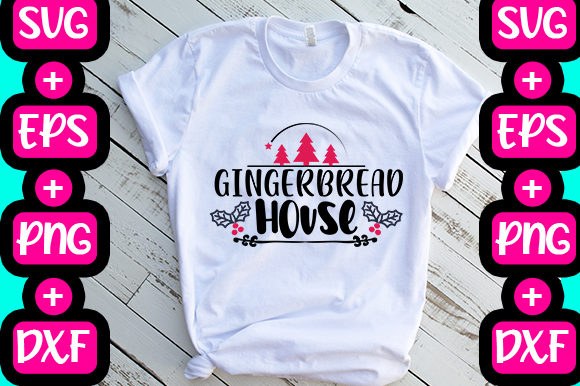
Opening Gingerbread House for the first time, I felt that familiar designer spark—the kind that says, “This has mood, not just shape.” It’s not a generic candy cane or snowflake; it’s a fully realized, hand-drawn–style gingerbread structure with textured icing lines, subtle cookie cracks, and playful architectural charm. The silhouette reads clearly at a glance, but the details—like piped windows, gumdrop accents, and a slightly lopsided roof—add warmth and handmade authenticity. For a client project tied to holiday gifting, local markets, or small-batch confections, Gingerbread House delivers immediate emotional resonance without feeling cliché.
A Natural Fit for Handmade Business Branding
I recently scoped this asset for a client launching a seasonal line of artisan hot cocoa mixes and ceramic mugs. Their brand voice is cozy, nostalgic, and intentionally imperfect—think chalkboard labels, linen packaging, and Instagram stories shot on film. Gingerbread House slotted in perfectly as a hero graphic for their product mockups, social media banners, and limited-edition gift tags. It elevated their visual identity by reinforcing theme *and* tone—not just “it’s Christmas,” but “it’s *your* Christmas, made with care.” That nuance matters when you’re competing in a crowded creative marketplace where visual trust hinges on consistency and personality.
Where Gingerbread House Shines in Real Design Work
- T-shirt design: Crisp vector outlines hold up beautifully on screen-printed cotton or sublimation polyester—especially when layered over earthy heathers or cream fabrics.
- Packaging design: Works as a focal stamp on kraft boxes, jar labels, or belly bands—its moderate detail reads well at 2–3 inches tall without needing simplification.
- Social media graphics: Scales elegantly for Instagram carousels and Pinterest pins; pairs effortlessly with serif or handwritten fonts for editorial-style holiday posts.
- Cricut project & printable design: The included SVG and DXF files cut cleanly on vinyl and cardstock—ideal for custom ornaments, greeting cards, or shop window decals.
- Brand identity support: Functions best as a secondary element—not a logo, but a recurring motif across email headers, website banners, and Etsy product thumbnails.
Where to Use Gingerbread House With Intention
This isn’t a one-size-fits-all graphic design asset. Its charm lies in its character—but that same character demands thoughtful placement. Avoid using Gingerbread House in minimalist corporate branding, legal disclaimers, or ultra-clean tech campaigns. It loses impact—and risks looking out of place—on busy backgrounds, low-contrast surfaces (e.g., light gray on white), or layouts already dense with illustration. In logo design? Not ideal as a primary mark unless the brand is deeply rooted in confectionery or craft culture. As a supporting element in a holiday-themed Canva template or digital product bundle? Absolutely.
Design Performance Across Formats & Surfaces
I tested Gingerbread House across real-world outputs: printed on matte sticker paper, mocked up on a unisex tee, embedded in a Shopify banner, and scaled down to 48px for a favicon variant. The SVG retained full editability—easy to recolor for brand palettes or isolate elements like the roof or door. The PNG came with clean transparency, no fringing—critical for seamless layering in web design or editorial layouts. The EPS opened flawlessly in Illustrator for font pairing tests; it held visual weight beside both bold sans serifs (for modern contrast) and delicate script fonts (for harmony). The DXF imported cleanly into Cricut Design Space—no node cleanup needed.
Practical Designer Notes Before Client Use
- Always test Gingerbread House in black and white—some details vanish if contrast drops below 70%.
- Preview on both light and dark backgrounds; the icing lines pop best against warm neutrals, not stark white.
- Check file integrity: Open the SVG in Illustrator and inspect anchor points—this one has smooth curves, no stray paths.
- Verify commercial license scope—this is a commercial design asset, but confirm usage rights cover your client’s distribution model (e.g., print-on-demand, Etsy product, wholesale packaging).
- Run a print test: Output at actual size on your intended substrate—some textures soften on matte paper versus glossy vinyl.
- Assess visual hierarchy: Does Gingerbread House compete with body copy or CTAs? Often works best as a decorative accent, not a dominant focal point.
Why This Graphic Design Asset Earns a Spot in My Toolkit
Gingerbread House isn’t just clipart—it’s a mood-setter, a storytelling device, and a versatile creative design component. For small business branding, it bridges craft and commerce. For digital sellers, it adds instant seasonality to listings without requiring custom illustration. For marketers building a holiday campaign, it delivers recognition and warmth faster than a custom brief ever could. And for designers managing tight deadlines? It’s a polished, production-ready piece that respects both aesthetic integrity and technical rigor.
Final Thought: Context Is Everything
The value of Gingerbread House isn’t in its file count—SVG, DXF, EPS, PNG—it’s in how thoughtfully it integrates into a larger visual system. Used with intention, it strengthens brand consistency. Paired with strong typography and intentional whitespace, it elevates rather than distracts. But drop it into the wrong layout, ignore contrast checks, or skip licensing verification, and even the most charming illustration can undermine professionalism. So yes—I’ll use Gingerbread House on my next client project. But only after testing it where it counts: on real fabric, real paper, real screens, and real people’s expectations.