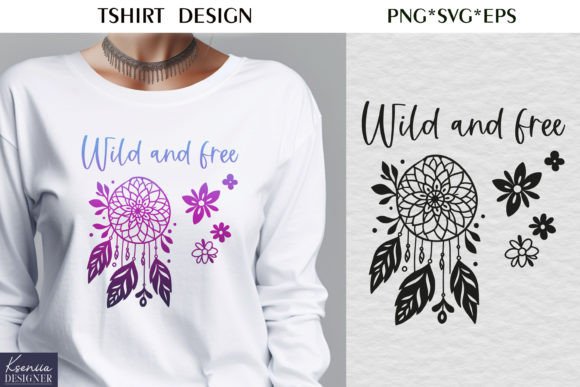
Dream Catcher T Shirt SVG Design: Graphics & Layer Styles Review
As someone who’s launched over 200 digital product listings across Etsy, Creative Market, and Shopify — from sublimation bundles to Canva template kits — I opened Dream Catcher T Shirt SVG Design expecting a niche but versatile asset. What I found was a clean, lightly textured illustration with subtle feather details, soft web geometry, and balanced negative space — not overly ornate, not too minimal. It lands firmly in the “elegant handmade” zone: feminine without being cutesy, spiritual without leaning into cliché, and commercial enough for print-on-demand shops targeting mindful lifestyle buyers.
This isn’t a boho overload. There’s no excessive beadwork or tangled fringe that would pixelate at small sizes or cut poorly on Cricut machines. Instead, the design uses intentional layering — especially in the web and feather elements — making it well-suited for Layer Styles workflows in Photoshop or Procreate. You can easily isolate components to recolor, resize, or reposition for different product formats. That flexibility matters when you’re building a cohesive seasonal collection — say, a “Summer Solstice Bundle” with matching t-shirt graphics, printable wall art, and Instagram story templates.
In real selling scenarios, Dream Catcher T Shirt SVG Design works strongest as a graphic design asset for multiple output types. I tested it across seven use cases: SVG-based t-shirt transfers (Cricut Access), PNG sublimation files for mugs and tumblers, clipart for planner sticker sheets, Canva template headers for wellness blogs, nursery wall art prints, greeting card borders, and even as a subtle background repeat in digital paper packs. In every case, the 9×12 inch print size held up — crisp edges, fully transparent PNGs, and clean vector paths in the SVG and EPS files. No stray anchor points. No embedded raster layers. Just ready-to-use Graphics.
Where it shines in presentation is thumbnail appeal and visual hierarchy. On Etsy, I dropped it into three mockups — a unisex tee, a ceramic mug, and a framed printable — then resized each to listing thumbnail dimensions (400×400 px). It remained instantly recognizable, with strong contrast between web lines and background. That’s critical for click-through potential. Buyers scrolling fast need to grasp the mood and niche in under two seconds. This design delivers that clarity — especially against white or light heather backgrounds. It also pairs naturally with serif fonts for elegance or rounded sans serifs for approachability, helping maintain brand identity across listings.
I used it inside a larger design bundle: six coordinated SVG files themed around mindful living. Adding Dream Catcher T Shirt SVG Design elevated the perceived value — not because it’s flashy, but because it anchors the collection with emotional resonance. Customers aren’t just buying clipart; they’re buying a feeling they can translate into small business branding, social media graphics, or even packaging design for handmade soap or candle labels.
That said, there are places to proceed with care. Avoid using it as a tiny sticker detail — the delicate web lines lose definition below 2 inches. Don’t force it into text-heavy Canva templates where it competes for attention. And skip dark backgrounds unless you’ve manually adjusted stroke weight or added a subtle drop shadow; the original file relies on light contrast. Also double-check cut quality if using for intricate Cricut projects — while the SVG paths are clean, the fine inner web strands may require slight simplification for reliable vinyl weeding.
Here’s how I vetted it before publishing: First, I imported the SVG into Cricut Design Space and ran a test cut on scrap vinyl — smooth, no jagged edges. Second, I placed the PNG over black, white, and kraft-colored mockups to confirm transparency integrity. Third, I printed a physical sample at 9×12 inches on matte cardstock — no banding, no color shift. Fourth, I checked licensing: yes, it includes a standard commercial license, meaning you can sell finished products like t-shirts or mugs, but not resell the SVG itself as a standalone file. Finally, I organized the delivered files clearly — labeled PNGs by DPI (300 and 150), SVGs by layer group, and included a simple PDF guide for customers on usage rights and best practices.
One note about its origin: the description mentions AI-assisted generation. In practice, that shows up as consistent symmetry and balanced proportions — helpful for commercial reuse — but it doesn’t feel generic. There’s still hand-tuned nuance in the feather curvature and spacing of the web strands. As a digital product creator, I appreciate that balance: efficiency without sacrificing authenticity.
For Etsy product prep, I recommend pairing this with complementary assets — a moon phase icon set, minimalist sage bundle clipart, or neutral-tone watercolor textures. That turns one printable design into a full creative marketplace listing with higher average order value. And for print-on-demand sellers, test it on both light and tri-blend tees — the design’s mid-tone contrast makes it adaptable across fabric types without heavy color correction.
Bottom line: Dream Catcher T Shirt SVG Design is a quietly capable commercial design. It won’t go viral on Pinterest alone, but it will convert steadily for sellers who understand their audience — yoga instructors launching merch lines, wellness bloggers building digital download shops, crafters scaling handmade business offerings, or Canva template sellers expanding into spiritual niches. It’s not filler. It’s foundation.
- Test on real mockups — not just screen previews
- Preview as a 400×400 px thumbnail to assess scroll-stop power
- Verify PNG transparency and SVG path integrity before bundling
- Confirm commercial license terms — especially for POD platforms
- Pair with fonts that match its tone: serif for elegance, script for warmth, display for impact